Taking Over Failed Dental Treatments
Home Dental has a team of specialists specializing in the consultation and management of dental complications. We understand that you may have received dental treatment outside of Hong Kong and are suffering from complications as a result. These complications may include implant misalignment, crown loosening, root canal failure, worsening periodontitis, and more, affecting your oral health, chewing function, and even your appearance. Seeking a professional dentist who can properly handle defects from overseas dental treatment is not easy, and we are committed to filling this gap.
Our Professional Services
- Rich Experience in Treating Overseas Treatment Complications - Our dental team has extensive experience in professionally assessing and developing treatment plans for various complications you may encounter after receiving treatment abroad.
- Multidisciplinary Team Collaboration - Specialists from different fields work together to comprehensively assess your oral condition and develop the most suitable treatment plan.
- Advanced Technology and Procedures - Combining internationally recognized dental technology and the expertise of senior dentists to ensure precision and effectiveness of the treatment.
- Transparent Communication and Personalized Plans - We focus on communicating with patients, explaining the deficiencies of existing treatment plans in detail, and developing personalized corrective plans based on your needs.
How to Conduct Corrective Treatment?
For patients who have received improper dental treatment elsewhere, we offer a range of corrective consultation and treatment services, including:
1. Implants Failure
Incorrectly installed implants can cause various problems, from aesthetic issues to impaired chewing and speech functions, and can easily lead to food and bacterial retention, causing ongoing gum infections or early implant failure. Peri-implantitis may lead to severe bone and gum tissue loss, making secondary implants extremely difficult or even impossible.
For issues such as implant misalignment, crooked teeth, and unnatural gum contours, we can reposition implants through professional surgery and implant techniques to achieve aesthetic and practical implant effects.
For bone and gum tissue loss caused by peri-implantitis, we can take effective treatment measures to stop the progression of inflammation and create conditions for secondary implants.
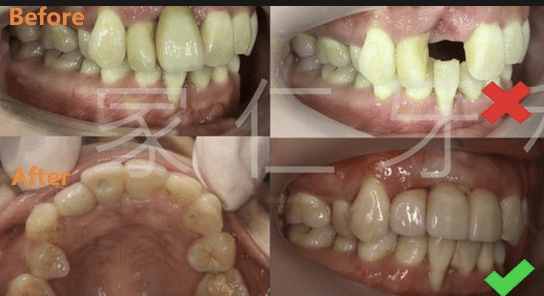
Left Image: Improperly Positioned Implant
- Issue: Implant misalignment causing crooked teeth and unnatural gum contours, affecting overall aesthetics and function.
- Impacts:
- Impaired chewing function
- Impaired speech
- Decreased confidence in smiling
- Possible gum inflammation and periodontal disease
- Potential implant failure
Right Image: Repaired Implant
- Repair: Correctly positioned implant, with properly aligned teeth, healthy gums, and natural contours, restoring aesthetics and function.
- Advantages:
- Restored chewing function
- Restored speech
- Rebuilt confident smile
- Maintained oral health
- Extended implant lifespan
Further Details? Please watch our exclusive video - Dental Implant Success and Failure Case Discussion
2. Veneers Failure
Poorly installed veneers can cause gum irritation, tooth sensitivity, and damage to natural teeth. We can remove the original veneers and create new, well-fitted veneers to restore oral health and aesthetics through professional dental techniques.
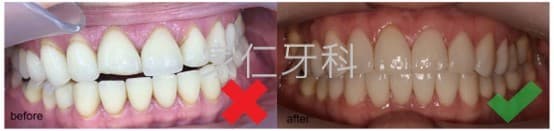
Left Image: Poorly Installed Veneers
- Gaps between veneers and teeth, leading to plaque accumulation, gum inflammation, and recession.
- Veneer color mismatch with natural teeth, affecting overall aesthetics.
- Rough veneer material causing tooth sensitivity and discomfort.
Right Image: Professionally Repaired Veneers
- Perfect fit between veneers and teeth edges, effectively blocking bacterial invasion and preventing gum inflammation and recession.
- Seamless color match between veneers and natural teeth, achieving a natural and aesthetic effect.
- High-quality, smooth, and comfortable veneer material, avoiding tooth sensitivity and discomfort.
3. Crowns and Bridges Failure
Crowns and bridges are essential dental restoration methods used to repair damaged or missing teeth, restoring oral function and aesthetics. However, improper installation can lead to issues such as bite problems, decay under the crowns, and aesthetic concerns. We can replace or remake crowns and bridges through professional dental techniques to restore oral function and aesthetics.
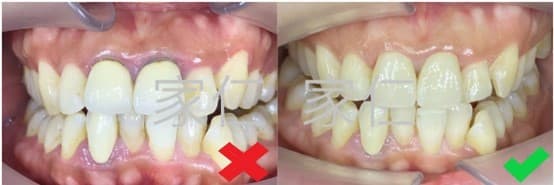
Left Image: Poorly Installed Crowns and Bridges
- Poor fit between crowns, bridges, and teeth edges, leading to food debris accumulation and increased risk of decay and periodontal disease.
- Color mismatch with natural teeth, affecting overall aesthetics.
- Oversized crowns and bridges causing bite discomfort.
Right Image: Professionally Repaired Crowns and Bridges
- Perfect fit between crowns, bridges, and teeth edges, effectively blocking bacterial invasion and preventing decay and periodontal disease.
- Seamless color match with natural teeth, achieving a natural and aesthetic effect.
- Appropriate size of crowns and bridges, ensuring comfortable bite.
Further Details? Please watch our exclusive video - Solving Common Dental Crown Issues? Expert Tips for Fixing Unsatisfactory Treatments
4. Root Canal Treatment Failure
Incomplete or incorrect root canal treatment can leave infected tissues, causing persistent pain, swelling, and requiring additional treatment. Re-infection after root canal treatment may initially show no symptoms as the tooth nerve is already dead. However, most cases still require removal if infection is found, as persistent chronic infection is like a ticking time bomb, potentially causing severe infection outbreaks, including cysts that erode adjacent tissues (including bones and other healthy teeth), leading to complex surgeries.
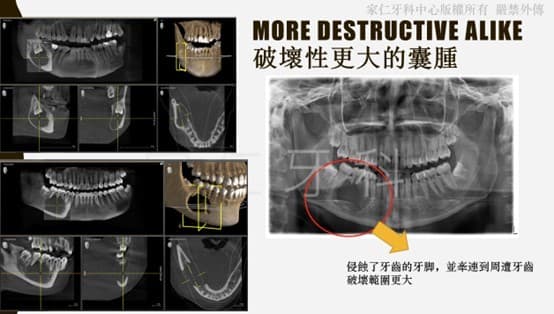
We can perform root canal treatment again through professional dental techniques to clear infected tissues and restore tooth health.
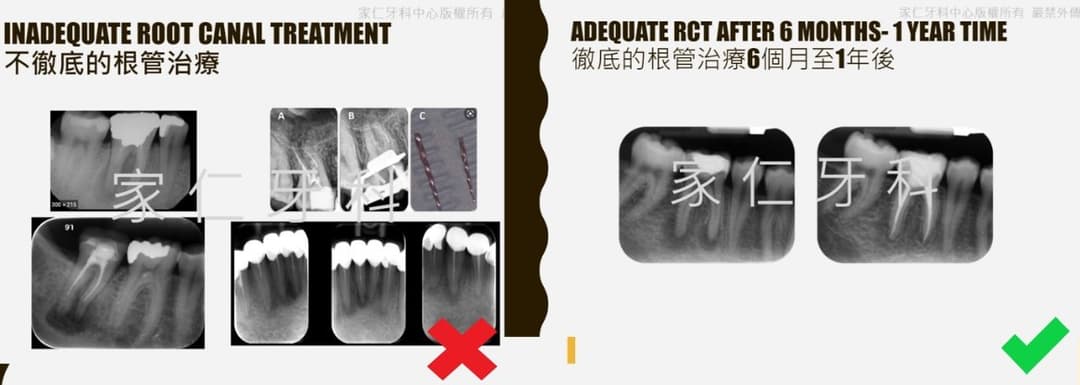
Left Image: Failed Root Canal Treatment
- Issue: Incomplete root canal treatment, leaving necrotic tissues that cause persistent pain, swelling, and inflammation.
- X-ray: Incomplete cleaning of the root canal, visible infection around the root tip.
Right Image: Corrected Root Canal Treatment
- Treatment Process: Re-open the root canal, thoroughly remove necrotic tissues around the root tip, disinfect, fill the root canal, and finally restore the crown.
- X-ray: Clear root canal and surrounding tissues, no visible inflammation.
- Improvement: Elimination of pain, swelling, and inflammation, restored tooth function, and extended tooth lifespan.
5. Fillings Failure
All dental treatments, including fillings, have certain limitations and lifespans. Regardless of the reason, cracked or dislodged fillings expose the tooth to risks of secondary decay and pulp infection. Repeated incidents can lead to various dental issues, including sensitivity and pain, causing patient distress. Repairing fillings may be necessary to prevent further bacterial leakage, thereby avoiding secondary decay or structural damage to the tooth.
However, in some cases, the repaired tooth has already lost too much of its original structure, making it prone to fractures and further damage. Early intervention to prevent further damage may be necessary to extend the lifespan of the repaired tooth.
We can perform fillings or root canal treatments again through professional dental techniques to repair damaged teeth and prevent further dental issues.
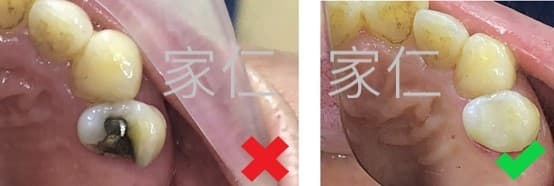
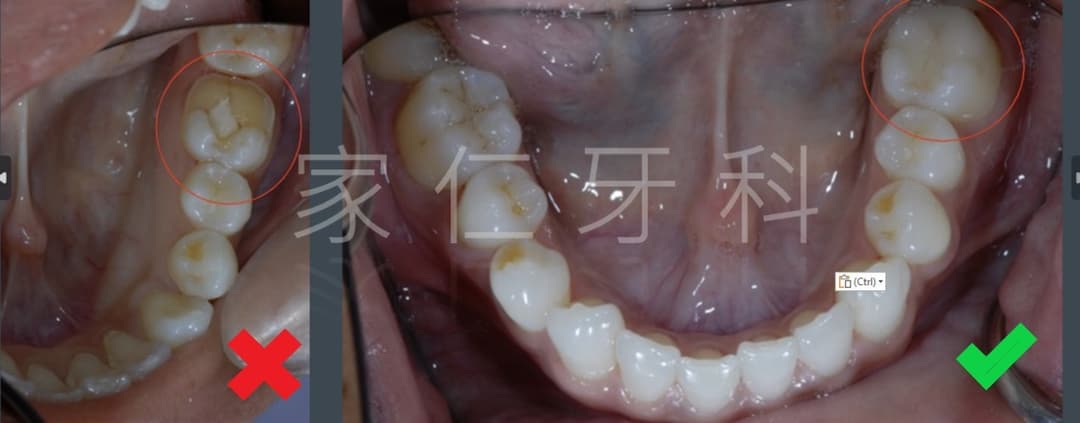
Left Image: Poor Quality Filling
- Issue: Poor quality filling material with poor fit to the tooth, leading to food debris accumulation, secondary decay, and causing pain and sensitivity.
- Appearance: Filling material color mismatch with natural teeth, affecting overall aesthetics.
Right Image: Professional Filling
- Treatment Process:
- Remove poor quality filling material.
- Clear decayed tissues.
- Use high-quality filling material to precisely fill the cavity.
- Polish the tooth surface to restore smoothness.
- Appearance: Seamless color match with natural teeth, restoring natural aesthetics.
- Improvement: Prevent secondary decay, eliminate pain and sensitivity, and extend tooth lifespan.
6. Periodontal Treatment Failure
Untreated or poorly maintained periodontal health can lead to disease progression, tooth loss, and systemic health issues. Long-term stability of periodontal disease is crucial. However, many factors need to be considered to maintain stability, including the patient's health condition, oral hygiene habits, and insufficient regular check-ups and maintenance. Each patient is unique, and understanding the obstacles and risk factors to overcome is crucial for achieving high-standard treatment outcomes.
We can develop professional periodontal treatment plans to control the progression of periodontal disease and maintain your oral health.
7. Full Mouth Rehabilitation Failure
Properly planned and executed full mouth rehabilitation services are designed for patients requiring extensive dental work to correct multiple issues, ensuring improved function and aesthetics. However, patients need to understand that in oral rehabilitation, it's not always possible to hit the "RESTART" button. Constructing oral prostheses is not like building a house that can be demolished and rebuilt. Since the oral cavity contains living tissues, improper treatment can cause irreversible damage to soft and hard tissues, and even with extensive effort and time, further treatment options may be very limited.
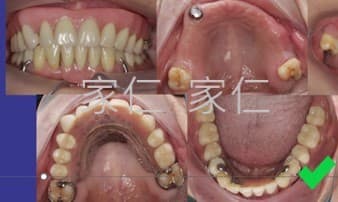
We can develop personalized full mouth rehabilitation plans based on your specific situation to maximize the restoration of your oral function and aesthetics.
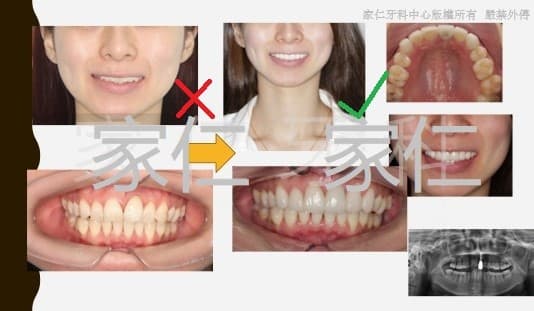
Image: The comparison shows the oral health condition of a patient before and after full mouth rehabilitation treatment. Through a series of professional and comprehensive dental treatments, the patient successfully restored oral function and aesthetics.
Further Details? Please watch our exclusive video - Full Mouth Rehabilitation: All-on-4 and Other Options – Pros and Risks Explained
8. Orthodontics Treatment Failure
Incorrect orthodontic treatment may fail to correct misalignment, leading to ongoing bite issues and uneven tooth wear, causing jaw pain and oral hygiene problems. Additionally, if not detected and corrected early, improper orthodontic planning and execution may result in irreversible aesthetic damage, including severe gum recession, excessive loosening, root resorption, and tooth necrosis.
We can develop new orthodontic plans through professional orthodontic techniques to correct bite issues, uneven tooth wear, jaw pain, and oral hygiene problems caused by incorrect orthodontic treatment, restoring oral function and aesthetics.
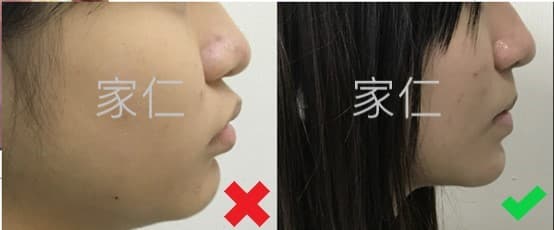
Left Image: Failed Orthodontic Case
- Issue: Improper orthodontic plan causing misaligned teeth and bite issues. Poor-quality orthodontic materials leading to root resorption and gum recession.
- Appearance: Misaligned teeth and unattractive smile.
Right Image: Corrected Orthodontic Case
- Treatment Process: Professional orthodontists assess the failure reasons, develop personalized plans, and use advanced orthodontic materials (e.g., invisible aligners) for treatment.
- Improvement: Properly aligned teeth, restored bite function, improved chewing and speech. Advanced materials reduce enamel wear, lower risk of root resorption and gum recession.
- Appearance: Naturally aesthetic smile, boosted confidence.
Seek Professional Advice for Informed Decisions
If you have any questions about improving your current dental condition, be sure to consult a qualified dental professional for a detailed assessment and personalized consultation. Only in this way can you obtain sufficient information to make an informed decision that suits you best.
If you have any questions or need to make an appointment, please contact us.
How to make an appointment?
1. Click the WhatsApp button on the website (priority recommendation) - get in touch with us now!
2. Call 3956 9387 (during office hours)